Hola! Bonjour! Hi :D. This week we look at a molluscan invasive species that has affected the marine environment, the Green Crab.
(Scientific name: Carcinus maenas).
 |
| The Green Crab. ©MISA |
Distribution
The Green Crab is native to Europe and Northern Africa but has found its way to the coasts of North America, parts of South America, South Africa and southern Australia. It was first discovered in 1817 on the east coast of North America. Its mode of introduction into these exotic habitats are due to several reasons: ballast water from ships, attachment to the hull of ships and migration on surface sea currents.
 |
| Global distribution of Green Crab. Stars represent local regions, circles represent exotic introductions, triangles represent failed survival of introduction. ©Her Majesty the Queen in Right of Canada |
What made this particular IAS so successful?
Yet again this IAS is another one of those invasive species with insane tolerance ranges. I think this is the most extreme. The adult Carcinus maenas population can:
- Exist in salinities between 4 and 54%!
- Survive in temperature ranges of 0-33°C!
- Can go without eat for up to 3 MONTHS!!!
However this species is as voracious a predator as the lionfish. It feeds on a wide range of organisms including mollusks bivalves and crustaceans.
Impact
Just like every other invasive species we've examined, this voracious predator has greatly impacted marine ecosystems and on commercial fisheries. Reports have shown that this invasive species has resulted in the loss of nearly $44 million dollars in the commercial fisheries sector. This species has directly affected juvenile fish populations resulting in the reduction of the adult population of fish for commercial purposes.
Methods of Mitigation
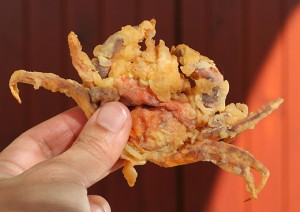 |
| Fried Green Crab. © The Earth Invaders |
With this species, native organisms have fought back to protect their ecosystem. In North America, the Chesapeake blue crab (Callinectes sapidus) was observed to drastically reduce the green crab population resulting in environmental control of the organisms. Many anthropological ways have been implemented as well such as the commercializing of said exotic species. Yet another example of how the implementation of the over exploitative nature of humans to combat yet another invasive species.
