Hola! Bonjour! Hi :D. This week we look at one of the most voracious invasive species to affect the marine environment, the lionfish
(Scientific name: Pterois volitans).
(Scientific name: Pterois volitans).
 |
| The Red Lionfish.©Bent Christensen |
Distribution
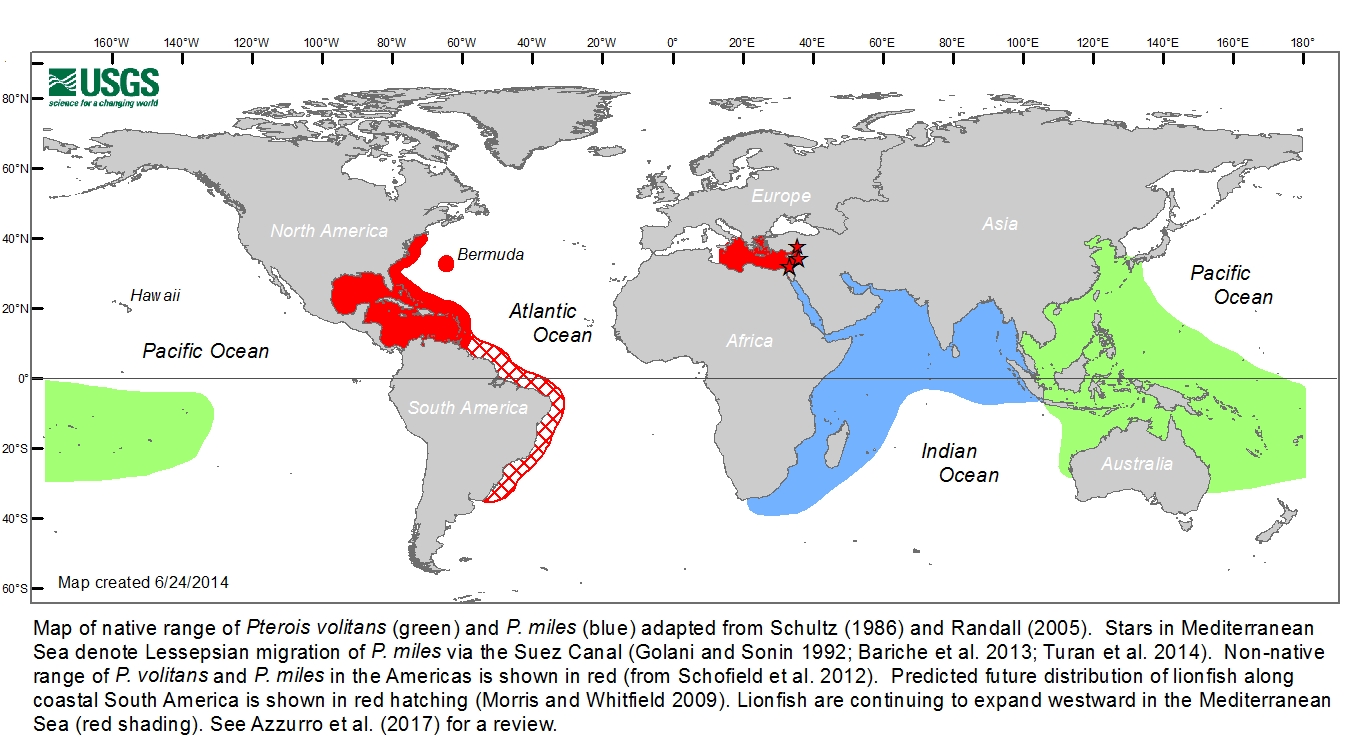
The red lionfish is native to the indo-pacific region but has found its way into unwanted waters such as the Atlantic, closer to North America (spotted in 2002), the Gulf of Mexico, the Caribbean Sea, spotted in countries such as: Cuba (2007), Jamaica (2008) and Trinidad and Tobago (2010). The lionfish is regarded as one of the most beautiful additions to any household aquarium. Scientists speculate that the dumping of the lionfish into waterways via the aquarium trade is one of the main modes of introduction of this species into non-native areas.
What makes this particular IAS so successful?
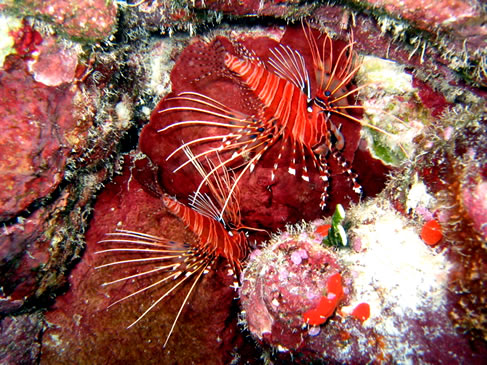 |
| The red lionfish camouflaging in its natural habitat (the coral reef) using its striped color. ©The University of Wisconsin |
Impact
The ferocious lionfish has the ability to severely impact coral reef ecosystems negatively. By disrupting the stability of the ecosystem and rapidly declining local fish populations, this directly impacts the fishery and tourism sectors of countries highly dependent on this resource. Hixon et al (2009) observed that this IAS has the ability to reduce juvenile fish populations up to 79% within a span of 5 weeks! The video below shows how the lionfish feeds and why it is capable of such devastation!
Methods of Mitigation
 |
| Lionfish being spearfished in Florida. ©National Geographic |
 |
| Lionfish cuisine being promoted in a restaurant. ©Erin Spencer |

No comments:
Post a Comment